Setting up a game
Both players bring a deck of exactly 50 cards — Digimon, Tamers and Options mixed — plus a Digi-Egg deck of up to five. You may run at most four copies of any single card number, so two cards with the same Digimon name but different numbers are different cards. You shuffle, place both decks face down, play rock-paper-scissors for who goes first, draw five cards, and may throw that hand back once for a fresh five if you hate it.
Then you take the top five cards of your deck, one at a time, and lay them face down as your security stack without looking at them. The memory counter starts at 0. That's the whole setup — no separate life totals, no resource cards, nothing else on the table.
The four phases of a turn
A turn runs in a fixed order: unsuspend, draw, breeding, main. In the unsuspend phase everything you had tapped sideways stands back up. In the draw phase you take one card — except the very first player, who skips their first draw. The breeding phase gives you exactly one of two actions, and the main phase is where everything else happens: play a Digimon or Tamer, digivolve, use an Option card, link a card, attack, or pass.
Memory is the clock
The memory gauge is one shared track running from 10 on your side to 10 on your opponent's, and the counter sits on 0 at the start. Paying a cost means moving the counter toward your opponent's side. The instant it comes to rest on their side of zero, your turn is over — even mid-combo, even if you had more plays in hand. If it lands back on exactly 0, your turn keeps going.
That single rule is why the game reads as a conversation rather than two solitaires. Every expensive card you play is handing your opponent the same amount of tempo, and the skill is in spending it so that what you built survives their reply. Two consequences catch new players:
- Passing is a real cost. Choosing to end your main phase sets the counter to 3 on your opponent's side. If you only had 1 memory left anyway, passing gives them more than overspending would have.
- The gauge caps at 10. A 13-cost card needs you to be holding at least 3 memory already; you cannot pay it from 0 no matter how much the opponent has.
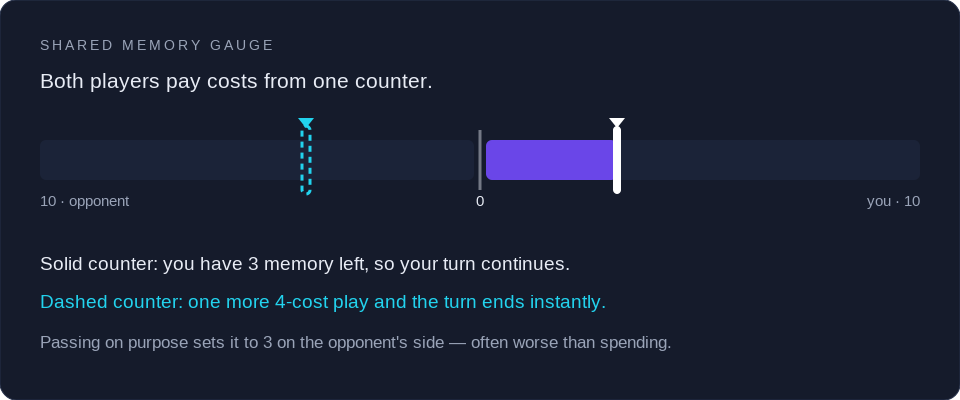
Try the memory gauge trainer if you want to feel the turn flip before you sit in a real match — it is the mechanic that decides most beginner games.
Attacks and security checks
To attack, you suspend the attacking Digimon and choose a target: the opponent's Digimon, or the opponent themselves. Attacking the player is how you win, and it works like this. Each attack against the player performs a security check, flipping the top card of their security stack face up. If that card is a Digimon, it fights your attacker on the spot; if your attacker dies to it, the attack stops there. If the card is an Option or Tamer, it goes to the trash and the attack has gone through.
When a player's security stack is empty and an attack still performs a security check against them, that player loses. There is one other way out: if you have to draw and your deck is empty, you lose.
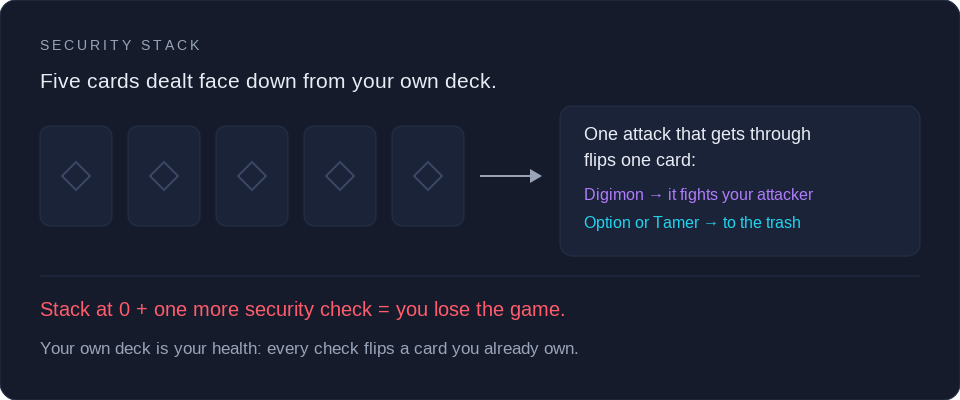
The practical read is that a security stack is not a wall you break down with one big hit — it is five chances for your opponent's own deck to answer you. Options sitting in security fire their [Security] effects on the way out, which is why attacking blindly into five cards is how new players lose games they were winning.
Digivolution and the breeding area
Digivolution is the engine. You take a card from your hand and stack it on top of a Digimon you already have, provided the colour matches and the level is one higher, and you pay that card's digivolution cost instead of its full play cost. You draw a card when you digivolve. The stack underneath stays there and keeps feeding inherited effects upward, so the low-level card you played on turn two is still doing work on turn eight.
The breeding area is where growth gets a head start. During your breeding phase you may either hatch a Digi-Egg into it, or move the Digimon already in it out to the battle area — one of those two, not both. Only one card may sit in the breeding area, and while it is there your opponent's effects cannot touch it, which makes it the safest place to build a Digimon up before you commit it to the board.
What to do in your first hour
Play story mode to the end of its tutorial section before you touch ranked. It introduces cards, memory and security one at a time, and it pays cards as you clear it, which matters more than it sounds: your first deck is whatever the game gave you. Open the free daily pack every single day, claim anything sitting in the home-screen mail, and don't spend on packs until you know which colour you actually enjoy — the six colours play differently enough that a deck built from your favourite is better than a deck built from your rarest card. Once you have a few games behind you, read the seven mistakes that lose games — it is the fastest way to stop making the same one twice.