What Digimon Alysion actually is
Digimon Alysion is Bandai's official free-to-play version of the Digimon Card Game for iOS and Android. It launched worldwide on November 25, 2026, in 183 countries and regions, in English, Japanese, Simplified Chinese, Traditional Chinese and Korean. There is no PC client and no browser version. If a site offers you a "PC download" or an APK of a "desktop edition", it is not official, and this wiki does not link to it.
The cards are the paper game's cards, plus a set of cards made only for the app. The rules are the paper rules too: a 50-card deck with at most four copies of any card number, a Digi-Egg deck of up to five, five face-down security cards standing in for your health, and one shared memory gauge that both players pay from. What is rebuilt is everything around them — a touch interface that lets you put several cards down at once, an original story mode that teaches the rules while you play it, ranked and casual online battles, and a breeding screen where you raise a Digimon up to Mega and record what you meet in the Digidex, which holds more than 100 entries at launch.
The story is set in the world of Digimon Liberator, the vertical webcomic that has been running since 2024. You follow a new cast rather than the anime's, starting with Kanata Hondo and her partner Gemmon, and the game leans on the idea that this is a virtual card world people log into.
The three things that decide a match
Memory is shared, and it is the turn timer. Both players pay costs from one gauge that runs from 10 on your side to 10 on your opponent's. When you spend and the counter comes to rest on your opponent's side, your turn ends immediately — you do not get to finish what you were doing. Passing on purpose sets the gauge to 3 on their side, which is why passing is usually the worst option on the board. The counter also caps at 10, so a card that costs 13 needs you to already hold at least 3.
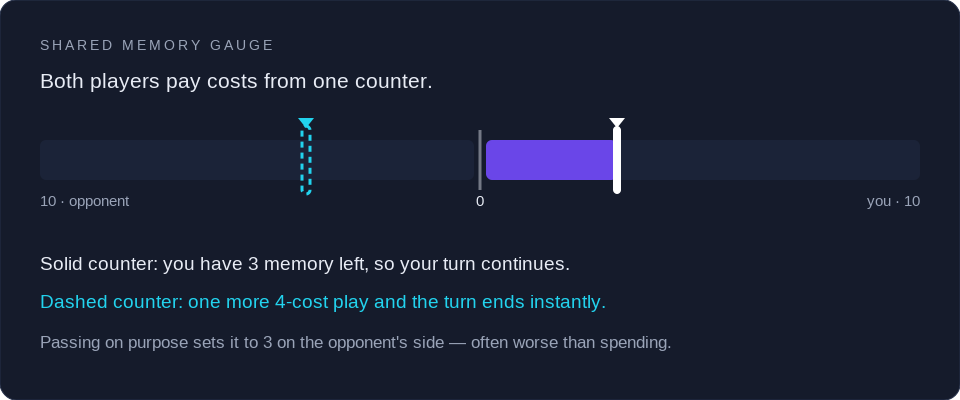
Security is your health, and it is made of your own deck. You begin with five cards taken face down from the top of your deck. Every attack that gets through flips one of them, and whatever is under it can fire its [Security] effect in your defence. When the stack is empty and another attack gets through, you lose. That is the whole defensive game: you are not blocking, you are spending cards you already own.
Digivolution is growth, not summoning. You play a low-level Digimon, then stack a higher-level card on top of it by paying that card's digivolution cost, which is cheaper than playing it from scratch, and you draw a card when you do it. The breeding area holds one Digimon at a time, out of reach of your opponent's effects, and you either hatch a Digi-Egg there or move the Digimon out to the battle area during your breeding phase — one of those, not both.
What day one looks like
Launch week comes with more free cards than a normal week will. The pre-registration campaign passed its final 450,000 milestone, so every tier paid out: pack tickets across BD-01 to BD-04, a parallel Agumon, WarGreymon, MetalGarurumon, Omnimon, Gemmon, a ticket that guarantees a SEC card, and roughly 240 cards' worth of packs in total. If you signed up before launch, those arrive in the in-game mail on the home screen and there is no code to type. A free pack also lands every single day, which is the real engine of the collection.
There is a launch event, Battle Carnival Ver. Dukemon, running in the event tab, and two paid routes into ready-made decks: buying an Unlock Key to open Deck Missions and clearing them, or buying the physical ST-25 / ST-26 starter decks, which ship with a code that puts the same deck into your account.
What this wiki covers, and what it does not
This site is written and checked by players, and it sticks to things that can be verified: how the rules work, what shipped in each set, which codes are real, how the app runs on a desktop, and where the game is available. Where the community does not know something yet, the page says so instead of filling the gap.
That is deliberate. The game is days old, so there is no honest tier list yet — no one has enough ranked matches behind them to rank archetypes, and the deck lists floating around are built from paper-era cards that do not account for the app-only pool. When that changes, the tier list will appear here with the match counts behind it. Until then, the fastest way to get ahead is to understand memory and security properly, which is what the rest of this wiki is for.